The growth of Techno House music in Europe : rewind in the 90s

The roots of Techno House music in USA : Chicago, Detroit (& NYC!)

Hello, hello, this is C again from MINIMALER, I hope you’re doing great today as we’re back at it with the second podcast about the Techno House musical scene, and so as I was discussing further about its growth in Europe last week, now it’s time to focus on the very roots of it : Chicago and Detroit, but also New York in USA. Indeed, last week I’ve been introducing you to the 90s/2000s ish period of this industry evolution in Europe, I hope you’ve been enjoying this little puzzle piece of history, I mean I feel like it’s cool to understand where everything is coming from, and so today let’s not waste anymore time because we’re rewinding even earlier back in the 80s.

In the last episode as I was focusing on venues, I’ve been checking my facts by filtering the internet, this said for today’s episode, I’ve been finding many information within a couple books which I feel interesting to mention in case anyone would like to go further on the Techno and House topics, the first one is « Last Night a Dj Saved My Life » and I feel like it’s after the track name since this one from NY based group Indeep has been released in 1982 so anyways, this book has been written by Bill Brewster and Frank Broughton – two freelance writers specialized on dance music back then – and published in 1999, and let me tell you it’s a real source of understanding as for musical connections between House and Techno scenes.

The second book I’m gonna base myself on has also been written by Bill Brewster and Frank Broughton and it is a compilation of interviews they did during their editor’s career, this one has been published in 2010 and it’s titled « The Record Players ». I’m going to split this episode within three parts, the first is going to be about House music in Chicago, Illinois, the second part will be focused on Techno music from Detroit, Michigan, and the third and last one will be all about connecting the dots between these cities and Europe, in order to enable a broader vision of how House and Techno music scenes have been rising during the 80s and the 90s there, but also how these scenes from USA have been part of the very first to be inclusive of gay people as soon as the early 80s, leading the western world to follow their footsteps not only music wise, as I said in the previous podcast, but also tolerance wise. So let’s start.

Black and white photo of Chicago city downtown seen from a playing field, USA.

Chicago, Illinois

Let’s begin with House music, and although House music is well-known to be born in Chicago, it is actually thanks to three persons from New York City that its creation in Chicago has been possible, I said Robert Williams, Larry Levan and Frankie Knuckles. Indeed, it all starts in New York where Robert Williams, a juvenile counsellor and party goer, met with Larry Levan and Frankie Knuckles who were both underaged by this time, studying textile design as the Fashion Institute of Technology. The story says that Larry and Frankie were arrested after they stole some doughnuts from a food truck at the end of a party and were therefore arrested by the police who sent them in a juvenile camp for a couple weeks in the Bronx, and as you see everything happens for a reason even the ones that can be felt negative, because this is exactly due to their conviction in this juvenile camp that Larry Levan and Frankie Knuckles have been meeting with their juvenile counsellor, and yes, this was Robert Williams. All of them would become real friends over time, and by 1974 Robert Williams moved from New York to Chicago, Illinois, where he started to host after-hours parties where he was welcoming his friends Frankie Knuckles and Larry Levan, until he opened a club called the Warehouse where he asked Frankie to become a resident, which made him move as well to Chicago by 1977 when the club launched, and this is the beginning of their lifetime business partnership.

For the anecdote – which was actually given by Frankie Knuckles himself in an interview from 1995 part of the second book I mentioned earlier – Robert Williams wanted to partner with Larry Levan in the very first place, nevertheless Larry wanted to stay in New York to open his own club, the formerly called Paradise Garage – turned into The Garage later -which was pioneering in the Big Apple in terms of inclusiveness, since it was known to be a temple for early dance music lovers but also for gay people, a place that has also seen over time the very first performances of artists like Diana Ross, Gloria Gaynor, Whitney Houston or Madonna. So, while Larry Levan was taking care of shaping the dance music scene in New York with his Paradise Garage club, where artists like Keith Haring, Jean Michel Basquiat, Roy Lichtenstein or Andy Warhol were holding exhibitions and hanging out in the nighttime – see how every arts scenes were connected by that time – this is nearly 1 200km away in Chicago that Robert Williams and Frankie Knuckles have been opening the Warehouse.

The Warehouse has been the playground of Frankie Knuckles ever since its opening, he actually called it his Church as it was only opened one day a week, even though that day was lasting sometimes as long as 72 hours. The Warehouse has been part of the first clubs in Chicago to host events with dancers who are predominantly black gay people – and quoting Frankie Knuckles, the Warehouse resident until 1982, from that 1995 interview – the crowd was seen as very spiritual and soulful, and of course they were truly enjoying this new music style he was playing there – maybe as much as the acid that was the main artificial friend back then. This said, there was a moment in the early 80s when the Warehouse became somehow victim of its own success, as the interest towards the so-called house music they were providing to music lovers was increasingly growing, what used to be a club enabling access to black gay people into clubs – because by the late 70s Chicago was seen as THE most segregated city of USA – turned into a more mainstream club welcoming straight white people too in the idea of inclusiveness, but in a very different manner : for example they doubled the entrance fee which led to the rise of a feeling of lack of respect within the crowd, something which was never ever experienced before at the Warehouse. In my opinion, this brings up a couple interesting points when you think about it.

First of all, this House music industry might have been the only one in the world, and especially back in the 70s in USA, to be first and foremost welcoming minorities in Chicago such as black gay people, and then opening it up to a broader audience of white straight people, I mean, through the work of Robert Williams, Frankie Knuckles and Larry Levan, I feel like this is not only the roots of house music that have been shaped, but also the roots of tolerance and open-mindedness towards each other. The second point I’m noticing is that mainstream might be the next step of underground since forever, because I feel like you’re underground when you do things from a starting point, and when this is working out, you’re kind of naturally going more mainstream because your audience is just growing, maybe keeping anything underground never ever been a possibility in the end, we should think about it also for today’s music. But anyways, back to Frankie Knuckles, even though he was rising as a huge influence on this musical scene and invited to play in other clubs in Chicago, these other clubs would most of the time not be welcoming his audience the same way their music customers would be at the Warehouse, and this eventually led him to leave the club and start a new adventure with the opening of his own club, the Power Plant.

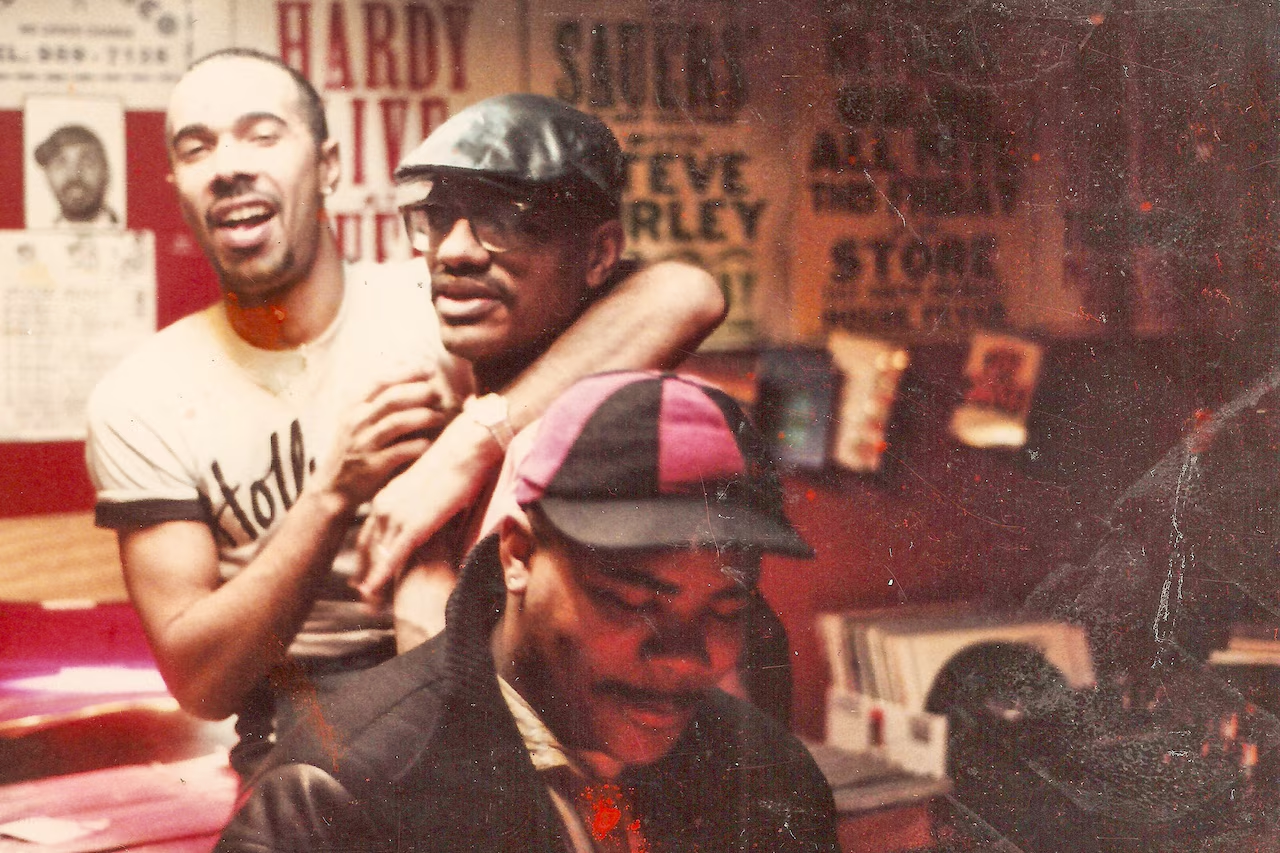
Unfortunately, Ron Hardy has been struggling with many addictions, and even though his mark with stay forever as the godfather of House music, he sadly passed away at the age of 33 only. A shift has been occurring in Chicago nightlife from the 90s with the rise of R&B music, as they tried to match it to House music, a cool idea will you say, but the thing is that it brought up more people who were not sharing the same essence of partying, however, more today renowned artists who were in their debuts kept on attending their performances such as Chez Damier, Marshall Jefferson or Jesse Saunders just to name a few, and even Derrick May was doing the trip from Detroit back then.

As it’s said in one of the very first House tracks produced ever « My House » from Rhythm Control released in 1987 :

« In the beginning there was Jack, and Jack had a groove, and from this groove came the groove of all grooves, and while one day viciously throwing down on his box, Jack boldly declared : Let there be House » 

Nevertheless, in the very beginning, you have to know that the word house was used for a long time not to describe a special musical genre, but actually more as an attitude or a feeling : basically anything could be house by this time, and actually I found a pretty interesting sentence in the book « Last Night a Dj Saved My Life » saying that if a song was house, it was music from a cool club, it was underground, it was something you’d never hear on the radio. On the same wavelength in Chicago, the right club could be house, and if you were going there, you would be house and so would be your friends – in a nutshell, they were seeing as a revenge for disco music in the first place, house was basically disco made by amateurs. This said, House music became a real style of music and defined as such by the mid-80s, while studio equipments were starting to become smaller and more affordable, pushing a first wave of music producers to create and play their own House rhythms, leading them inevitably to become increasingly more committed to vinyl as well as the fact to run record labels. Almost overnight, Djs who used to struggle in filling the whole night with their collection of music just been served an army of young clubbers turned into music producers able to create numerous pieces of music with just a bunch of equipments, which they were even able to press on vinyl with a few hundreds of dollars at that time. And here again I would say this is interesting because even today, performers are the ones who are sharing their passion to their crowds and obviously it pushes that ON button within the ones who were keen to make it happen subconsciously, I mean just in Paris since I’m familiar with this kind of parties, I’m telling you many used to be clubbers turned into producers or promoters, and I could bet this is just the same everywhere – this is all about inspiration and transmission.

Let’s talk a minute about Jesse Saunders, because he’s seen as the first music producer for House music, yes, because the legend says that during the early 80s, Jesse Saunders was regularly playing a track which was the « On and on » remix from Mach and one night his record copy was stolen during his gig and so he decided to use the loop from that track in order to recreate it, and he released it on his very first label Jes Say Records – the catalog number for this release was JS999 and this version of Jesse Saunders is still regarded by many as being the first recorded house release, and even though it can be felt as somewhat basic, it gave many people the determination to try by themselves to create their House music. On the other hand, another artist is seen as the creator of the first House music track and this is Jamie Principle with his track « Your Love » which was felt as so good by this time that very few people believed it could even had been made by anyone in Chicago, but anyways because it was actually made by someone in the city, this created here again the desire in many rising artists to try themselves to create this kind of amazing house music, both Jesse Saunders and Jamie Principle have been showing a way or another that it is possible, and this has been marking the beginning of the House Music era when it comes to music production.

Dj Pierre, another pioneer artist from Chicago who was Djing since his teenage years and started to play at Lil Louis parties there, and he’s the one who has later been introducing the Acid House music. Did you know that in the first place, Acid House music tracks were actually made by accident, like as Dj Pierre said it himself, it was basically just ignorance in the sense he and his friends just didn’t know how to use the 303 machine, they troubleshooted it a bit and just created a track out of the blue : Acid House was born with his « Acid Trax ». No real relation but a fun fact I found in an interview of Dj Pierre about this underground scene back then, it’s that to be a part of House music communities, there was a dress code and you were actually supposed to be really well dressed, like with nice clothes and shiny shoes, so I feel it funny how things have evolved.

Detroit, Michigan

Let’s now go to Detroit by the early 90s, where Marc Kinchen who is one of the pioneer Djs of Detroit, Michigan, and better known as MK was saying that there are millions of people in Detroit but that he would think about only thirty of them would have heard about Techno. As part of those who would have heard about it, there was Derrick May and Kevin Saunderson, both slightly younger than Ron Hardy and Frankie Knuckles, who were both regularly doing the trip down to Chicago by car to dance on their music, then heading back to Detroit with fresh ideas to create music balancing between old school House music and modern synthesized grooves.

Both of them were hanging out a lot with the younger brother of Juan Atkins, the three of them met in junior high school in Belleville, a suburb of Detroit, and the story says that in the very debuts, Juan Atkins was intimidating them as he was mostly focused on music and was barely talking to anyone, nevertheless one day they played chess together and so the ice broke up to the point they realized they were all connected by the same passion for music, and yet this growing new form of it : Techno music. Juan Atkins has been playing music since his very first years, playing bass and drums in garage funk bands, and somehow he always knew he would become a famous musician, or at least he knew he would do anything to make it happen. One of his very first projects released on vinyl was seen as a real turning point : indeed, when he released « Alleys of Your Mind » track under the Cybotron alias, most of people who would have heard it would be convinced that he would have been made quote/unquote by someone from someplace in Europe, although when they realized Juan Atkins was behind it but mostly that he was a teenager, people knew he rose the level up – and actually Juan Atkins has just revived his Cybotron alias after 28 years of inactivity recently with an already sold out release for Tresor record label.

As Detroit was rising as a new musical force, it found a huge support in Chicago, where clubs and parties were a huge revelation for them, for Derrick May it was a bit like a direct continuation of the European synthesizer tradition, keeping the Depeche Mode style up, actually at some point he even made of Chi-city his main goal music wise, and by the time he was about to release his creation « Strings of Life » his very first ambition was to have Ron Hardy and Frankie Knuckles playing it – and as a little tips, that track is about the death of Martin Luther King, and this is actually Frankie Knuckles who found its title after Derrick May gave him a early demo of it. In Detroit’s quiet suburbs you have space to expand your ideas, the chance to analyze your music and take it to another level, to take it seriously, and so as the Techno scene was steadily being shaped there, yet another key player came along to structure Techno music as we know it today, and yes this is of course Jeff Mills – ma passion – a Techno pioneer who has been evolving aside of the trio Juan, Kevin and Derrick although it was in the meantime, he’s been a huge inspiration to many since his very debuts. I actually remember the very first time I got to see Jeff Mills play in Paris, it was as part of his Time Tunnel tour back in 2014, and I will forever remember the feeling when I saw Jeff Mills play back from the crowd, with some of the first visual effects I was seeing during a performance, and I mean the music talks for itself when it’s Jeff Mills playing it, it’s a real musical Wizard.
And actually, do you know why Jeff Mills alias is the Wizard and where it’s coming from..? Basically back in his beginnings, he made his first steps as the successor of his older brother who was djing and just got married by the time, and so he started to learn how to dj in the theoretical sense of it as he was too young to legally get into clubs, with the friends of his brother – who were older – he learnt on how to read and handle a crowd, and ultimately started to play there from a couple hours to all night long shifts. By gaining more and more recognition, he’s been hired to host a radio show, something pretty common in terms of evolution back then, and so his show would be called The Wizard. Why the Wizard? Because the choice of the radio station was to hold an anonymous show, therefore Jeff Mills chose it because it was a nickname he was given due to his outstanding skills. He obviously evolved into the international career we all know about and has formed band such as Underground Resistance. Wether it is Ron Hardy, Frankie Knuckles, Larry Levan and Robert Williams for House music in Chicago, as well as Derrick May, Kevin Saunderson, Juan Atkins and Jeff Mills for Techno Music in Detroit, all of them have been building the overall structure for this Techno House scene to spread all over the world, and without their unique manner of translating disco music into electronic music and going beyond borders. A lot of the techniques, the music, the behaviors from the 80s in Chicago and Detroit have been kind of stamped to the late 90s in Europe, since this was a brand new manner of sharing music and mostly to be creating it.
So voila, that is wrapping up this second podcast transcript about the music industry, this podcast and more are available on Spotify so feel free to check them out!
MINIMALER Studio

Share your music feedback

This site uses Akismet to reduce spam. Learn how your comment data is processed.

READ MORE

Discover more from MINIMALER Studio

Subscribe now to keep reading and get access to the full archive.

Continue reading

Discover more from MINIMALER Studio

Subscribe now to keep reading and get access to the full archive.

Continue reading

THE BEST MUSIC

ALL TRUCKS

Track 01
$ 30
Track 01
$ 30
Track 01
$ 30